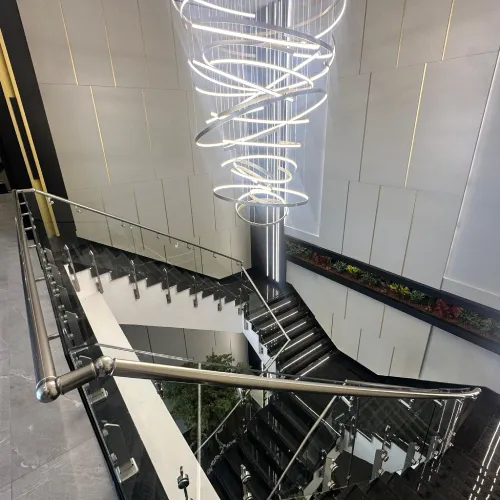
Why interior glass railing has become a defining feature of modern design
Interior glass railing has become one of the most effective ways to make a space feel open, elegant, and architecturally balanced. Instead of blocking light or creating heavy visual interruptions, glass railing helps interiors stay bright while still defining stairs, landings, gallery edges, and other elevated zones. Akos System presents its glass railing range in exactly this way, describing frameless and glass balustrade solutions as suitable for both indoor and outdoor spaces, with a clear emphasis on transparency, safety, and modern aesthetics.
That balance is especially important in interiors because a railing is often not just a safety feature. It is part of the visual language of the building. A well-designed interior glass railing can make a staircase feel lighter, a hallway feel wider, and an open-plan living area feel more continuous. Akos reflects this approach across its stair railing, handrail, and balustrade categories by treating glass as a structural design element rather than only a decorative one.
Akos System builds interior railing as part of a complete architectural system
Akos Smart Railings states that it was founded in Konya in 2000 and began manufacturing aluminum railing and glazing systems in 2006. The company says its product range includes aluminum railing systems, glass balcony accessories, and various aluminum structural elements, all produced to modern design and quality standards. That broader manufacturing base matters because interior glass railing is not usually a single isolated product. It often needs to work with stairs, handrails, glass panels, and other building elements in one coordinated system.
This is also why Akos’s architectural support is relevant. On its For Architects page, the company says it provides project planning, static calculation, visual design, and assembly guidance. For interior glass railing, that support is important because stair geometry, mounting conditions, finish selection, and load behavior all need to be resolved before fabrication and installation begin.
Interior glass railing works best when safety and openness are both protected
Akos’s frameless glass balustrades page makes the core argument clearly. The company describes these systems as a seamless and contemporary solution for both indoor and outdoor spaces, made from toughened safety glass and designed to provide elegant, minimalist aesthetics without compromising strength or durability. It also says the frameless design allows uninterrupted views, making it especially suitable for staircases and other interior spaces where openness matters.
That is exactly why interior glass railing has become so widely used in contemporary architecture. It lets the building retain visual continuity, daylight flow, and spatial openness while still creating a secure barrier at the edge of a stair or landing. Akos reinforces this point again on its frameless toughened glass balustrade page, where it describes the systems as sleek, modern, and resistant to impact, with strong indoor and outdoor application potential.
The stair railing family gives the category more depth
Akos does not treat interior glass railing as one generic product. On its stair railing page, the company describes stair railings as premium systems crafted from stainless steel, wood, and glass, designed to combine safety, functionality, and style. It says they are suitable for a range of architectural styles, from contemporary to traditional, and can be customized in materials, finishes, and designs to match the specific needs of the project.
This matters for interior design because not every project wants the same railing language. Some staircases need a very minimal glass-only look, while others need more visible structural presence through stainless steel or mixed-material details. Akos’s stair railing family gives designers enough flexibility to choose a solution that fits the interior rather than forcing every project into the same visual formula.
Handrail-supported glass systems are especially useful indoors
A major strength of the Akos offer is that it does not separate glass from handrail logic. On its Balustrades with Handrails page, the company describes these systems as a blend of functionality, safety, and style, noting that the addition of a handrail improves safety on staircases and elevated areas without compromising the sleek look of the glass. It also says these systems are suitable for both indoor and outdoor use.
The handrails page expands the material range further, stating that handrails can be made from stainless steel, aluminum, wood, and glass. That makes the category much more adaptable in interior architecture because it allows the railing to respond to wood floors, concrete finishes, metallic details, or more refined decorative interiors. For indoor spaces, that kind of flexibility often determines whether the railing feels integrated or simply added later.
Tempered and frameless systems strengthen the interior design effect
Akos’s glass balustrades page emphasizes that the systems are made from high-quality tempered glass and are designed to provide a clear, unobstructed view while ensuring robust security for residential and commercial properties. The page also states that these balustrades are ideal for staircases, balconies, and terraces and can be customized with polished stainless steel or anodized aluminum finishes.
For interior glass railing, this matters because a space is not only being protected. It is being shaped visually. Tempered glass preserves transparency and helps maintain a sense of openness, while the choice of finish allows the railing to match surrounding interior materials more naturally. Akos’s frameless and handrail-supported systems make it possible to move between minimalist and more structured looks depending on the project brief.
Project support makes the category more useful for architects and contractors
Interior glass railing usually requires more than a product catalog. It needs a supplier that can help with planning, engineering, and assembly details. Akos directly addresses this on its For Architects page, where it presents itself as a solution partner and describes project planning, static calculation, visual design, and assembly guides as part of its architectural support structure.
That kind of support is especially useful in interior projects where stair runs, void edges, landings, and gallery spaces often need exact coordination. A supplier that can support the project at the design stage is more valuable than one that only provides a standard railing profile. Akos’s pages suggest that the company is positioned to support that wider project workflow.
Quality control and certifications strengthen confidence in the system
Akos reinforces its product positioning with a strong quality framework. On its Quality Assurance page, the company states that safety and high product quality are paramount in its production processes, that it adopts best engineering practices, and that quality begins with careful raw material selection and continues through final delivery. It also says every product is backed by quality certifications and standards and that the company’s quality system is built on continuous improvement.
The certificates page adds further credibility by listing Akos Qualicoat Seaside, Akos Qualanod, Akos ISO 14001, Akos ISO 9001, Akos EN 15088, and Giordano certificates for product lines including SL10, SL11, EL50, Alumax Single Lama, and others. Even where those certificates are tied to broader system families, they still strengthen trust in the brand’s interior railing products because they show a serious manufacturing and compliance structure behind the offer.
A broader system family gives interior glass railing more design freedom
Akos’s media and product structure shows that interior glass railing sits inside a larger family that includes Glass Railing, Glass Spigot Balustrades, Balustrades with Handrails, Frameless Glass Balustrades, Frameless Glass Juliet Balcony, Button Glass Balustrade, Decking Glass Balustrade, Frameless Toughened Glass Balustrades, and Glass Balustrade Stairs. That matters because interior projects often move between staircase edges, landings, and open-plan transitions, and a supplier with a wider system family can support those different conditions more naturally.
It also means the category is not locked into one narrow style. A project can move from a fully frameless look to a handrail-supported solution or a mixed-material stair railing depending on the interior concept and the structural requirements. That flexibility gives designers more room to shape the space instead of adapting the space to a fixed railing system.
Interior glass railing that combines light safety and architectural clarity
What makes Akos especially strong in the interior glass railing category is the way it combines multiple decision factors under one manufacturer structure. The company offers frameless glass balustrades for maximum openness, stair railings for broader interior use, handrails for additional support, tempered glass balustrades for safety and transparency, and architectural support through project planning and static calculation.
For that reason, Akos is relevant not only for broad searches around interior glass railing, but also for more specific project needs such as stair glass railing, glass bannisters, frameless interior balustrades, handrail-supported glass systems, and architect-ready solutions for modern residential and commercial interiors.